On this page · 11 sections
From a network map to an itinerary
| Route | What matters in practice |
|---|---|
| Beijing West–Xi’an North | A fast run takes 4 hr 10 min. Compare the arrival with Xi’an Metro Line 2. |
| Shanghai Hongqiao–Beijing South | Direct G trains can take a little over four hours. Slower services might be cheaper. |
| Hong Kong West Kowloon–Shenzhen Futian | A fast journey takes about 14 minutes on board. Border formalities add substantial time. |
G trains can reach 350 km/h on selected routes. Intermediate stops, the infrastructure and the specific train determine journey time. Some cities have multiple stations far apart. Use a map to identify the corridor, then use the date-specific timetable for the route you will travel.
Read G, D, and C train numbers
G generally identifies the fastest long-distance services, D identifies another category of electric multiple-unit services, and C often serves intercity trips. Check the actual duration and station for each result. A train from a closer station with fewer stops can fit your day better than a higher class of train across town. Main corridors include Beijing to Shanghai and Guangzhou to Shenzhen, with high-speed services also linking Xi'an and Chengdu.
Decide which seat class earns its price
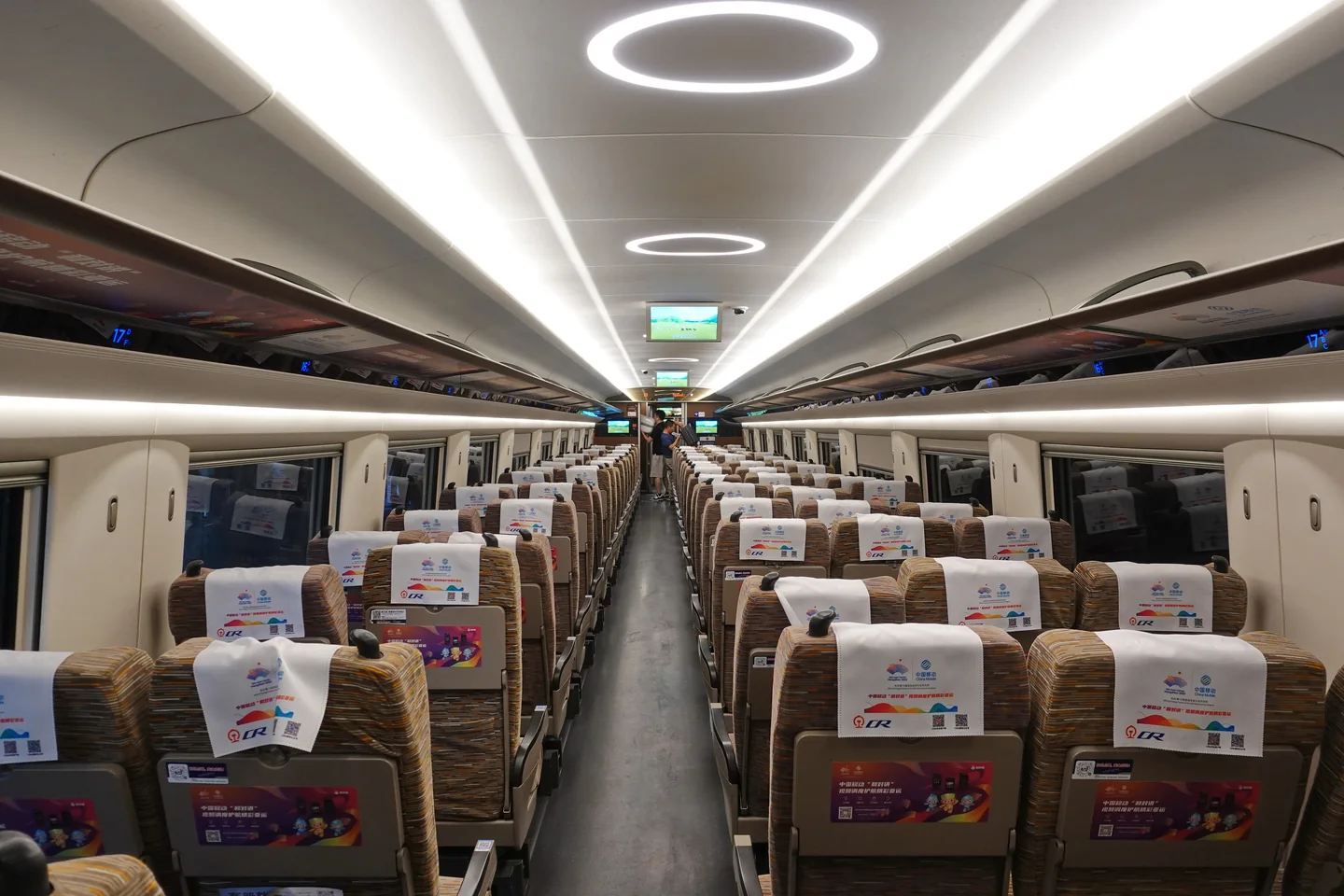
Second class on many trains has three seats on one side and two on the other. First class commonly has two on each side, and business class typically provides more space with different layouts across trainsets. Check the fare and where the seats are before paying. For two people in a standard second-class row, D and F are the aisle and window pair. A saved preference depends on availability.
Board with the travel document used to book
Search by exact station in 12306, buy with your passport details, and save the train number, coach, and seat. Take the same passport to the station and leave time for security. Look for the staffed gate if the scanner cannot read your passport. Confirm the station, metro connection, and check-in stop time for your departure.
Selecting a train, class and price
G services include the fastest mainline trains. D includes daytime units and some overnight services. C marks intercity services and can be useful between neighboring cities. Look for 卧 for a berth and 无座 for no assigned seat. Seat prices vary by service and date. In second class a couple can request the D/F pair and three travelers can request A/B/C, subject to availability. First class adds width and a business seat usually reclines further.
- Departure stationCity and station suffix
- ServiceTrain number and date
- BoardingCarriage, seat and gate
Booking before departure
The ordinary mainland sale window usually covers today and the following 14 days. Check your station’s ticket-release time and verify the passport before booking. 12306 charges the railway fare. An agency may add a fee or take a preorder before railway inventory opens. A confirmed order contains the train, station, coach and seat. A standby request remains pending until the railway issues it.
At the station and if your plan changes
Prepare the original passport, put bags through security, find the departure gate by train number and use the staffed lane if the automatic reader fails. Power banks need clear labeling and a rating of up to 100 Wh each. For ordinary refunds, fees are generally zero at least eight days out, then 5%, 10% or 20% as departure approaches. Check the actual refund amount and change fee on the order. Factors include when you apply and whether the new date is later.
Seat and berth choices on an actual departure
| Product shown | Layout or use | Question to settle |
|---|---|---|
| Second class 二等座 | Many daytime high-speed services arrange three seats across one aisle and two across the other. | On a conventional 3+2 row choose D/F for two travelers together if available. |
| First class 一等座 | Commonly 2+2 with more room and fewer passengers per row. | Compare the premium with the extra space you will use on that journey. |
| Business class 商务座 | Individual, more spacious premium seats. Hardware and included services vary by train. | Inspect the actual service before relying on an airport-style lounge, meal or particular seat. |
| Sleeper 卧铺 | Only selected departures sell berths. Conventional soft sleepers often have four berths per compartment and hard sleepers typically six per bay. Overnight D-train designs vary. | Check the calendar arrival date, berth type and whether a lower berth is confirmed. |
Station food, hot water and luggage
Large stations typically have toilets, shops and food counters inside the waiting hall. Eat before the train shows boarding or take packaged food to your seat. Trains commonly provide a hot-water dispenser, and some sell meals or support ordering through 12306. Pack a lidded cup and enough drinking water for the trip, particularly on a late departure. Keep pathways and doors clear when leaving your seat.
China Railway's published carry-on allowance for ordinary travelers is 20 kg per adult and 10 kg for children under its baggage rules. For EMU trains, length + width + height is generally limited to 130 cm per piece, and each item can weigh no more than 20 kg. Foldable wheelchairs used by disabled travelers are excluded from the ordinary limits. Check restricted items, and ask the origin station about oversized gear before departure.
Store a small bag overhead and place a larger case in the carriage luggage area if space permits. Keep your passport and valuables with you. Stations may have multiple enormous halls: 45–60 minutes before departure is a planning buffer for a first visit to a large terminal. Read the ticket gate's cutoff and allow more on a holiday or if you need help with luggage.
Compare the complete rail and air journeys
Consider a 4 hr 15 min train with 40 minutes to the origin station, 50 minutes at the terminal and 35 minutes after arrival: 6 hr 20 min door to door. A 2 hr 15 min flight with 1 hour to the airport, 2 hours before departure, 35 minutes for arrival and bags, and 1 hour to the hotel totals 6 hr 50 min. These are planning examples; replace each segment with the times for your own hotel, airport and booking. A direct long flight can win easily on routes that need two trains.
Frequently asked questions
How fast do high-speed trains run?
Selected G services operate at up to 350 km/h. Their average speed is lower because of stops and line restrictions. Check the elapsed time on your ticket search.
How large is the network?
China Railway reported 50,400 km of operating high-speed routes at the end of 2025. New lines can change the latest total.
How do G, D and C differ?
These letters identify different service categories. G includes the fastest mainline workings, D includes other multiple-unit services, and C generally designates intercity trains.
Can I travel with an overseas passport?
Yes. Book under the passport details you will carry and present the original document at checks.
Where should I find a useful route map?
Use a railway map for geography and the official 12306 timetable to check actual direct services, station names and intermediate stops on your date.
Free travel tools
More on the topics covered